
Why a shared language, a simple path and better data will move building materials further than another custom questionnaire
By Warren Neilson, Founder & CEO, Firecrown
The fastest way to an end goal isn't to lower the bar, it's to make the path direct and clearly defined.
The same is true for the Sustainable Materials Movement. The fastest way to make building materials healthier for people and the planet is to make the path to a high bar simple to take and the same for everyone to follow.
The Common Materials Framework (CMF), from the nonprofit mindful MATERIALS (mM), is a shared filing system for building product sustainability data. It sorts what 150+ ecolabels and standards verify into five impact areas, so buyers can ask for the same things the same way and manufacturers can answer once.
Ask any building product manufacturer what their sustainability team spends its week on, and you will hear some version of the same answer: questionnaires. Every owner, architect, and contractor sends a slightly different one. mM describes manufacturers fielding "hundreds, if not thousands" of bespoke, analog requests every week. Each one asks for roughly the same information, formatted differently, judged against different criteria.
That effort might feel like real progress but unfortunately most of it isn't. This is the cost of sustainability being paid over and over without moving a single product closer to healthier chemistry, lower embodied carbon or a real end-of-use pathway to circularity.
I spent last week at mindful MATERIALS' Forum Summit in Houston, TX and three ideas stood out. They also happen to shape how we at Firecrown think about materials programs for our clients:
High bar, simple path. Complexity is not rigor. It is a tax.
A shared language beats a better label. The industry has already proven this once, with carbon.
The plumbing matters more than the framework. And AI is changing what that plumbing needs to look like.

Image courtesy of mindful MATERIALS
High bar, simple path
There are two ways to run a materials program, and they produce very different markets.
The first sets a modest bar but wraps it in a complex process: a custom questionnaire, a proprietary scoring rubric, firm-specific terminology and a review cycle only your own team understands. Suppliers comply, but every hour they spend translating your requirements into their data is an hour not spent improving products. Multiply that across every buyer and the industry pays an enormous complexity tax for very little progress.
The second sets a high bar but makes the path to it simple: a common request, in a common language, that a manufacturer can answer once and reuse everywhere. Early adopters may pay a premium while the market catches up. But the effort goes into the product instead of the paperwork, and that is what drives cost down over time.
My bias is firmly toward the second. When in doubt, err on the side of a high bar and a simple path, not a lowered bar with complex requirements for reaching it.
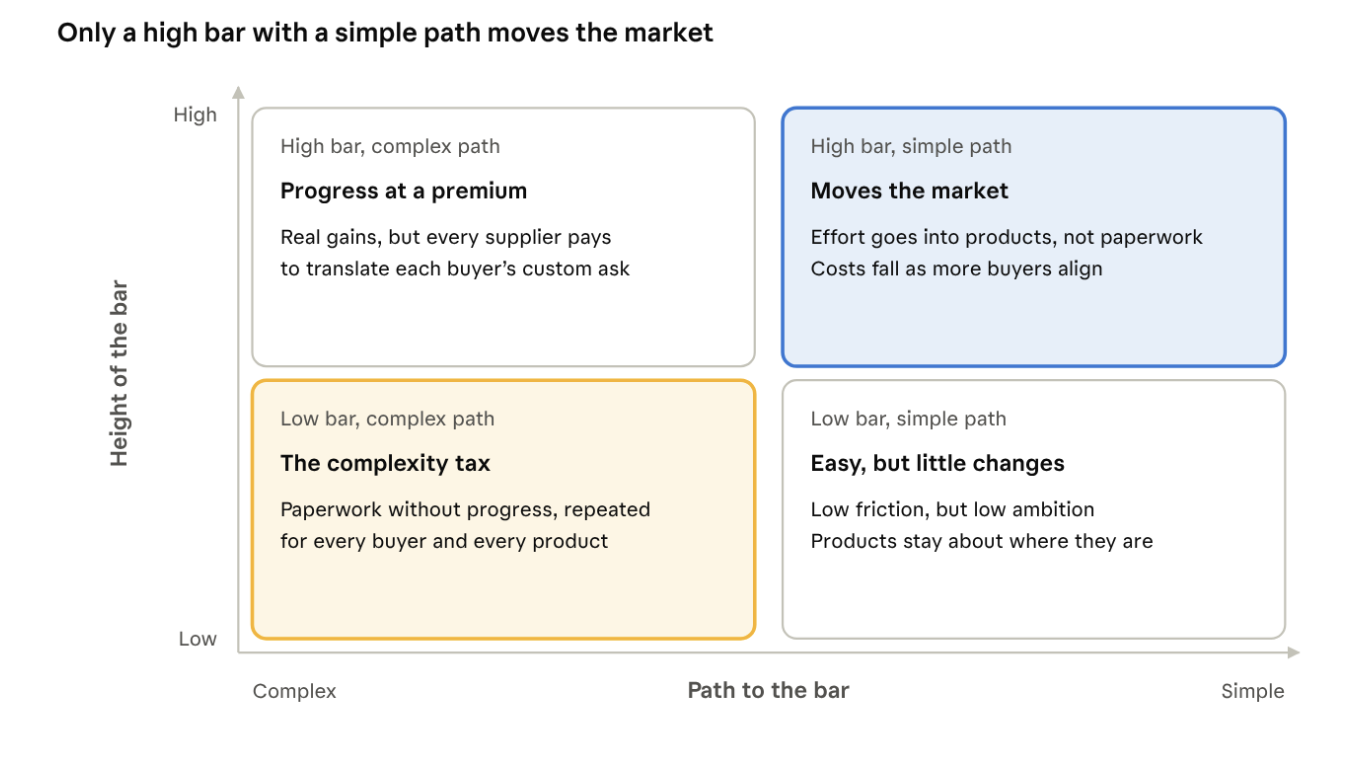
Two choices in every materials program: how high to set the bar, and how simple to make the path. Most programs unintentionally drift toward the lower left. The goal is to progress toward the upper right.
What the Common Ask and Common Give actually do
This is the idea at the practical heart of mM's work. The CMF organizes what 150+ ecolabels and standards verify into five impact areas: Human Health, Climate Health, Ecosystem Health, Social Health & Equity and Circular Economy. Built on top of it are two templates:
The Common Ask is one standard, CMF-structured request that any buyer can send to any manufacturer.
The Common Give is the manufacturer's one standard response, reusable for every customer.
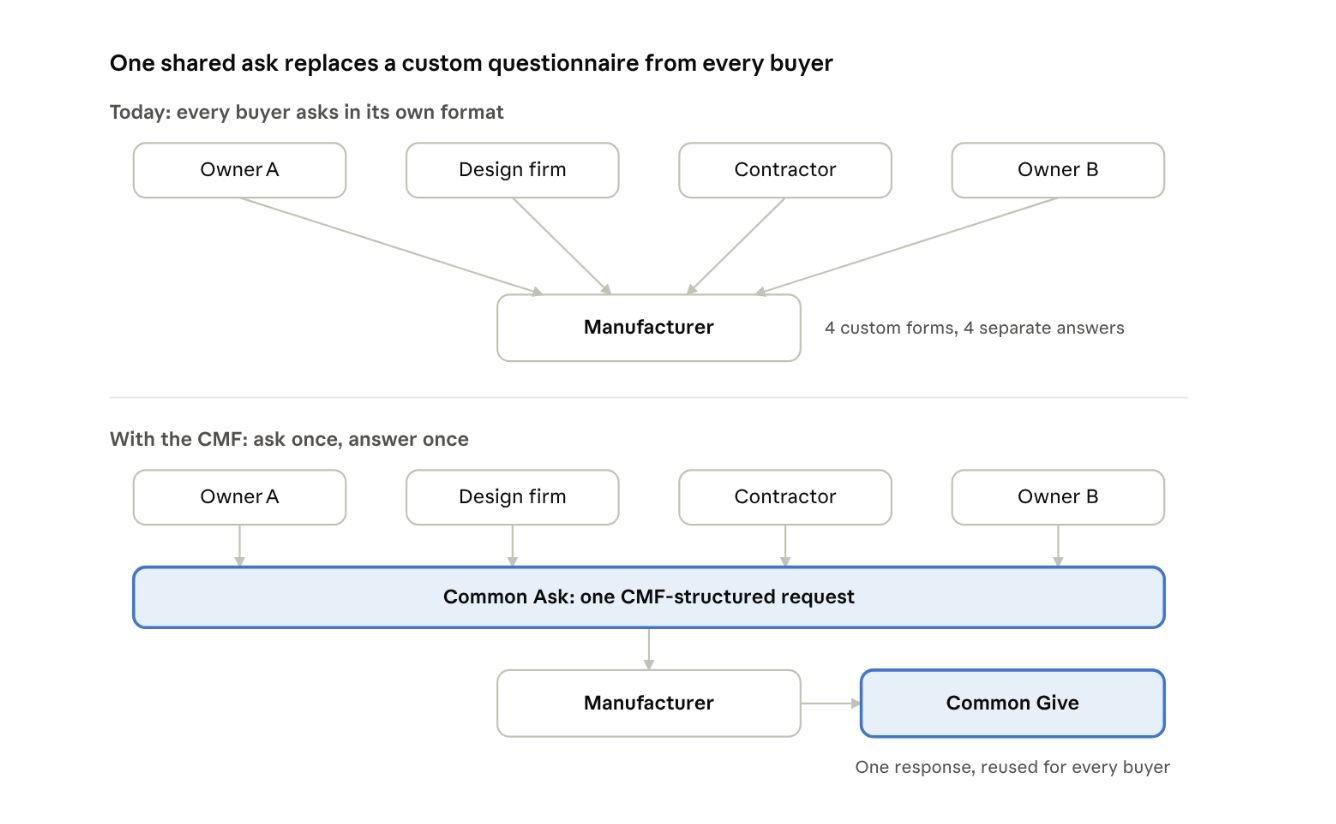
The Common Ask and Common Give, before and after. Same buyers, same manufacturer. A shared request format turns many answers into one.
mM's promise to manufacturers is simple: one response can fulfill multiple requests. The templates launched with the CMF Implementation Toolkit and CMF Prioritization v1.0 at Greenbuild in November 2025, built with more than 70 organizations. Prioritization v1.0 narrows the full framework to a working set of nearly 100 ecolabels and standards that owners and design teams actually ask for today.
Picture a Fortune 500 company that aligns its supplier requirements to the Common Ask. Three things happen at once. Manufacturers can reply faster, because they have likely answered the same questions for someone else. The market moves further, because the owner's demand reinforces everyone else's instead of fragmenting it. And sustainability program costs fall, because nobody is reinventing a questionnaire or chasing incomplete answers.
The honest catch: early adopters go first
mM is candid that this only works if a majority of the industry uses the CMF. It is a network-effect bet. The first owners and manufacturers to align carry the cost before the benefit of a shared standard fully arrives.
That is exactly why the early movers matter. Every major owner that uses the Common Ask instead of a custom form makes the next owner's decision easier, creating efficiency across the market. Every manufacturer that publishes a clean Common Give makes the template more valuable to buyers. In a business case, the early-adopter premium should be framed as an investment in market infrastructure, not a sustainability surcharge.
A shared language beats a better label: how the CMF aligns 150+ ecolabels
A simple path only exists if everyone means the same thing by the same words. That is the problem the CMF was built to solve.
Thirty years of good intentions, built separately
Over roughly three decades, independent organizations each created a certification, ecolabel or disclosure format to verify one kind of claim or other. Each was built for a good reason. But they differ in scope (one issue vs many), depth (disclosure only vs performance threshold), verification (self-declared vs third-party certified) and in what "sustainable" even means.
The result is a market fluent in dozens of incompatible dialects. A designer has to become an expert in every label to judge one product. An owner cannot benchmark a portfolio because every project team reports differently. A product can look "green" in one software tool and unremarkable in another.
We have already seen what alignment does
The best evidence for a shared language is embodied carbon. Once the industry had a shared metric (kg CO2e from an EPD) progress accelerated. Carbon became something specifiers could compare, set limits on and write into specifications.
But carbon is one of five kinds of impact. Toxic chemistry, ecosystem damage from sourcing, labor conditions in supply chains and end-of-use waste had no equivalent shared structure. The CMF is an attempt to give all five the treatment carbon has.
What the CMF is, and is not
mindful MATERIALS calls itself a convener, standard-setter and ecosystem builder, and describes itself as "the UN of Sustainable Materials." mM does not make the rules for any single product, it gets the rule-makers into one room.
The CMF takes each ecolabel apart, files every data point it verifies under one of five impact areas and 18 sub-areas, and records whether that data point shows mere disclosure or real improvement. That last distinction (mM calls it T.A.C.O.: Transparency, Assessment, Commitment, Optimization) is what keeps a product that simply publishes an ingredient list from looking identical to one that has actually removed harmful chemistry.
Just as important is what the CMF is NOT. It is NOT a certification, it is NOT a score and it does NOT set a bar. mM describes it as "the foundation, not the penthouse." Rating systems, owners and designers set their own thresholds on top of the CMF.
I find it helpful to see the whole system in three layers:
Product ecolabels (EPDs, HPDs, Declare, Cradle to Cradle and others) are the inputs.
Building rating systems (LEED, WELL, Living Building Challenge, BREEAM, Green Star) are the adopters.
Corporate sustainability programs and industry pledges (the AIA Materials Pledge, owner standards, firm product lists) are the demand.
The CMF sits in the middle and lets all three speak to each other, streamlining and simplifying data discovery. Ecolabels supply the facts, the CMF files them, and rating systems and corporate buyer programs decide what counts as good enough.
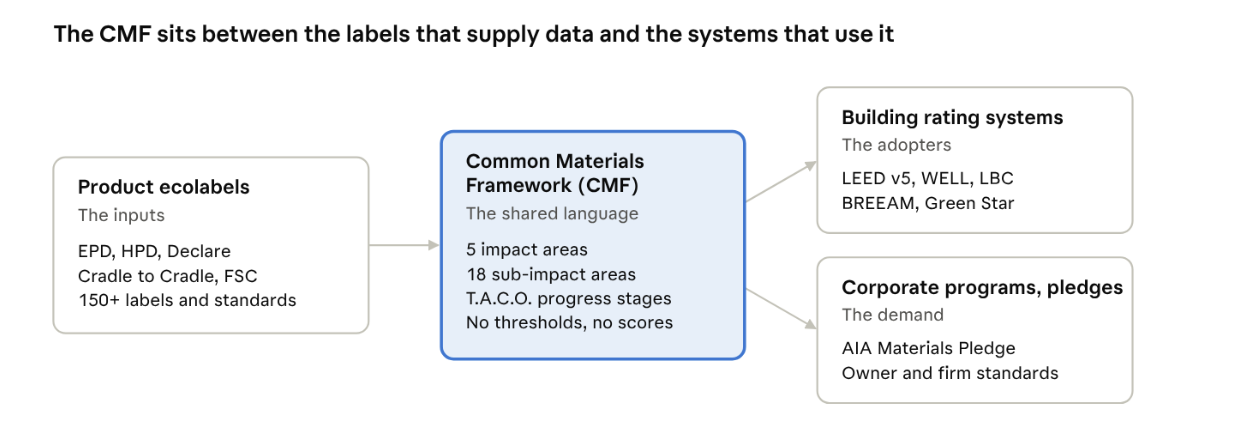
How the CMF connects ecolabels, rating systems and buyer programs.
A north star, not whack-a-mole
The five impact areas came from the AIA Materials Pledge. It began as an open letter from architects tired of a "whack-a-mole" pattern of demands: show us your carbon number, then now address health, then something else. They wanted a north star.
That is a useful lesson for any materials program. A north star sets direction at a high level so teams can act consistently. It does not require every product to perform on every impact category on day one.
Alignment is no longer theoretical. USGBC built the materials credit in LEED v5 on the same five areas, and LEED v5 became the only option for new commercial registrations in July 2026. In October 2025, the bodies behind BREEAM, Green Star, LEED, Living Building Challenge and WELL announced a partnership with mM to align their materials approaches, with the CMF as the backbone. For any owner or firm designing a materials program today, LEED v5 alone is reason enough to speak the CMF's language.
Alignment is the realistic step. Consolidation is the ideal.
Here is where I will go further than mM does. The ideal end state is not a dozen organizations agreeing on a shared vocabulary. It is those organizations combining their strengths into something that can move markets faster and at greater scale.
I recognize that is a long way off, and alignment is the practical step in that direction. mM's own 2026-2028 strategy preview points the same way, emphasizing that nonprofits should be coordinating rather than competing. The carbon story shows that alignment alone unlocks real progress. Imagine what deeper integration could do for the four impact areas still waiting for their EC3 moment.
The plumbing matters more than the framework: getting sustainability data out of PDFs
A shared language on paper does not simplify anyone's week. The CMF only helps if it is built into the tools where people actually choose products. mM's own data work makes a clear case: the vocabulary is largely settled, and the remaining problem is plumbing.
Most sustainability data still lives in PDFs
mM surveyed 17 priority ecolabel bodies in 2025 for its Ecolabel/Standard Digitization Journey Insights. Of the 13 that responded, only three were actively working to digitize their data endpoints. Five offered an API, though one of those only shares certificate PDFs rather than structured data, and five had a plan to expand their APIs to digitized data. Twelve said they would consider adopting mM's data schema, which is encouraging, but intent is not implementation.
mM identifies only three sources as fully digitized and connected today: Building Transparency's EC3 for EPDs, the HPD Collaborative's tools for Health Product Declarations, and Living Future's Declare database. All three cover just two of the five impact areas, Climate Health and Human Health. For everything else, "automated vetting" often still means someone reading PDFs behind the scenes.
This remains one of the biggest bottlenecks in the whole system.
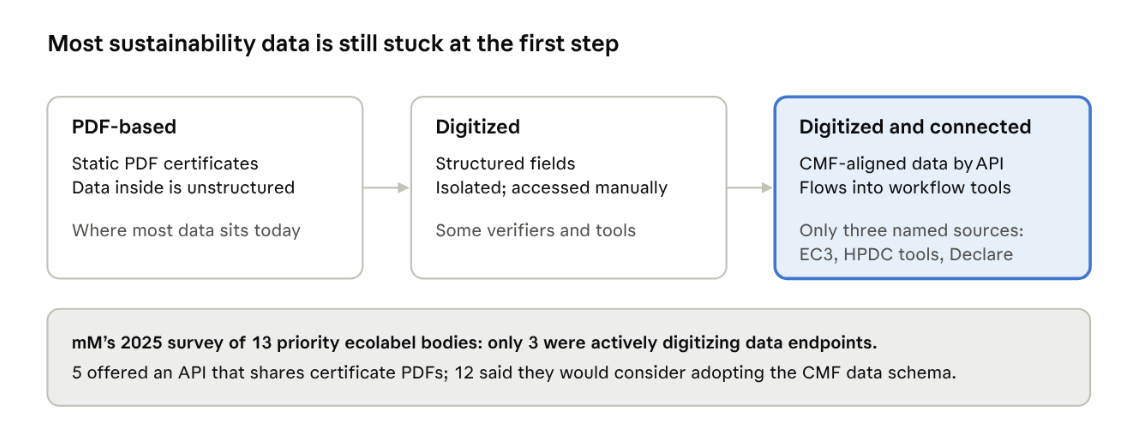
The three maturity tiers of product sustainability data, per mM's 2025 Data Ecosystem Report. The connected tier covers only Climate Health and Human Health today. The other three impact areas are still mostly PDFs.
The schema is the lever
mM's answer is the CMF Data Schema v1.0 (currently in beta), a shared JSON format that lets manufacturers and ecolabel bodies (the "Givers") send data that owners, architects and software tools (the "Receivers") can match against requirements. In my view, this is the single most important lever for mM to scale its vision. The framework tells everyone what to call things. The schema is what lets data actually move to where it is most useful for implementation.
Machine-readable, trusted data is what the industry needs
Software tools, and increasingly the AI built into them, are only as good as the data underneath them. As more specification, procurement and reporting work runs through these tools, the question is no longer whether a tool can read a certificate. It is whether the tool can trust what it reads and compare it consistently with everything else.
That is why organizing sustainability data in a machine-readable format matters so much. A PDF certificate shows a person what a product achieved. Structured data built on a shared schema tells software the same thing, in the same way, for every product, every ecolabel and every impact area. When an EPD's carbon value, an HPD's disclosure threshold and a recycled-content claim each sit at a defined CMF address, software tools can compare them, check them against a requirement and report on them without someone translating each document by hand.
The value goes deeper than formatting. A shared, machine-readable structure gives software a layer of trust, verifiability and alignment it cannot create on its own:
Trust in the data, and the ability to verify its source. A number alone is not enough. Tools, and the people using them, need to trace each value back to where it came from: which ecolabel or certifier issued it, whether it was third-party verified, which version of a standard it was tested against, and whether the certificate covers this product or a whole collection. A good schema carries that provenance alongside the value, so any claim can be checked at its source rather than taken on faith.
Alignment across every material, ecolabel and impact area. Today the same certificate can be categorized differently in each database. A common structure means every tool reads an EPD, a Declare label or a Cradle to Cradle certificate against the same five impact areas and the same T.A.C.O. stages.
A foundation AI can build on. AI-assisted tools are fast becoming how teams search, compare and report on products. Given clean, structured, verified data, they can automate vetting and reporting reliably. Given fragmented PDFs, they inherit every inconsistency and repeat it at scale.
mM is upfront about the remaining gap: its schema formats data but does not verify it, and bad data in a good format is still bad data. Its stated next phase, after connectivity, is prioritizing third-party verified data. Get both right, structure and verification, and software stops being a filing cabinet for PDFs. It becomes a trusted layer that lets every owner, designer and manufacturer act on the same facts, which is exactly what a simple path to a high bar requires.
What to do now: next steps for owners, design teams and manufacturers
If you are running or designing a materials program, a few moves follow directly from these ideas.
For owners and design teams:
Ask in the common language. Before writing a new supplier questionnaire, start from the Common Ask. Add to it only where your program genuinely needs something more. Every custom question you avoid is a cost your suppliers don't pass back to you.
Set the bar high and the path simple. Decide what level of evidence you require in each impact area, then make the route to it as plain as possible. Resist the urge to add process as a proxy for rigor.
Put thresholds in the specification. Carbon and VOC limits are increasingly written into project specs, which makes them enforceable through construction and harder to value-engineer away.
Use LEED v5 as your forcing function. Its materials credit already speaks the CMF's five-area language. Aligning your program to the same structure means less translation on every project.
Think of early adoption as an investment. If you are among the first to align, document the cost and the time saved, and frame both in your business case as building market infrastructure.
For manufacturers:
Answer once. Prepare a Common Give and make it your default response to sustainability questionnaires.
Clean the basics. Use one consistent company and product name everywhere. Avoid bundling a whole collection under one certificate if specifiers need to find individual products.
Get out of PDFs. Choose a source of truth for your product data and connect it to the platforms your customers use. Structured, verified data is becoming a competitive advantage.
Simple is not the same as easy
None of this is easy. A shared language has taken decades to build. The data plumbing is still being laid. And the organizations that move first will carry real costs before the network effect pays them back.
But the direction is clear. The materials market will not get healthier, decarbonize or become circular because buyers invent better questionnaires. It will move because buyers ask for the same things in the same way, set their own bar high, and make the path to it simple enough that manufacturers can spend their effort on better products instead of more paperwork.
At Firecrown, this is how we approach materials and circularity programs for our clients: ambitious targets, a simple path, aligned to the frameworks the market is converging on, and supported by digital tools rather than another layer of process. If you are building or rethinking a materials program and want to compare notes, we would love to hear from you. You can also explore more of our work on embodied carbon, circularity and healthy materials.
One more provocation on economics. Today anyone can use the CMF for free, and mM runs on a very small staff funded by memberships, sponsorships and Forum fees. Free access helps adoption. But shared infrastructure that the whole industry leans on needs a durable funding model. Go support mindful MATERIALS and the work they are doing to drive impact up and costs down. Their role in the building materials industry is critical for our continued progress towards a regenerative future.

Image courtesy of mindful MATERIALS
Common Materials Framework FAQ
What is the Common Materials Framework (CMF)?
A free, shared framework from the nonprofit mindful MATERIALS that organizes building product sustainability data from 150+ ecolabels and standards into five impact areas, so buyers and manufacturers use the same language.
Is the CMF a certification or a score?
No. It’s a common structure for organizing data. Rating systems, owners and design teams set their own thresholds on top of it.
What are the Common Ask and the Common Give?
Standard templates built on the CMF. The Common Ask is one request any buyer can send. The Common Give is one response a manufacturer can reuse for every customer.
How does the CMF relate to LEED v5?
LEED v5’s materials credit uses the same five impact areas as the CMF, so programs aligned to the CMF need less translation on LEED projects.
About the author: Warren Neilson is the Founder and CEO of Firecrown, an environmental sustainability advisory firm providing data science, strategy and implementation services to the world's most iconic brands. Warren brings 20 years of experience leading global sustainability programs and building projects for Fortune 500 companies, contributing to more than 450 million square feet of impact worldwide. Warren holds a Master's in Sustainable Development from the University of New South Wales, is a LEED and Green Star Accredited Professional and a Living Building Challenge Ambassador, and formerly taught green building at the University of San Francisco. Connect with Warren on LinkedIn.
Organized according to mindful MATERIALS' Common Materials Framework (CMF). Firecrown is not affiliated with or endorsed by mindful MATERIALS. Facts about mM, the CMF and its tools are drawn from mM's published materials, including its CMF Reference Guide, Implementation Toolkit and 2025 Data Ecosystem Report, as of November 2026.
